---
title: Unlock engineering value with open data and models
description: Renault, Boeing and BMW ditched document-driven engineering for connected models. Here's how openDEMS, openSPDM and Qarnot make the same shift possible.
image: https://www.info.hahsoftware.com/hubfs/NAFEMS%20brochure%20-%20flip%20book%20icon.png
---
[Skip to content](https://www.info.hahsoftware.com/hah-software-blog/unlock-engineering-value-with-open-data-and-models#main-content)
Homepage
- [Home](https://www.info.hahsoftware.com/home)
- [Our news](https://www.info.hahsoftware.com/our-news)
- [Our team](https://www.info.hahsoftware.com/our-team)
[Book a meeting](https://www.info.hahsoftware.com/book-a-meeting-or-demo)
- [Home](https://www.info.hahsoftware.com/home)
- [Our news](https://www.info.hahsoftware.com/our-news)
- [Our team](https://www.info.hahsoftware.com/our-team)
[Book a meeting](https://www.info.hahsoftware.com/book-a-meeting-or-demo)
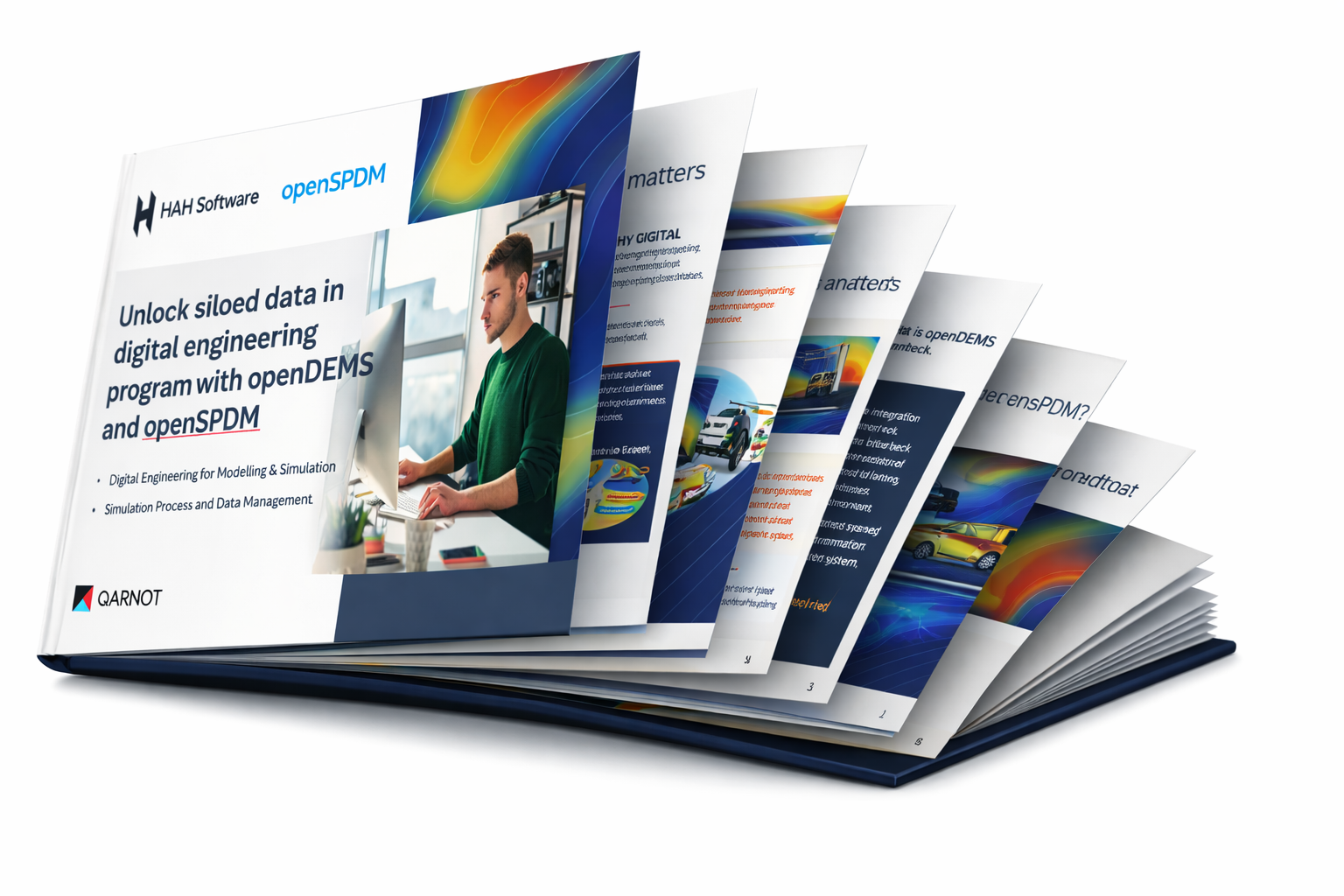
# Unlock engineering value with open data and models

Gavin Helinski
June 11, 2026
The shift from documents to open and simulation models is here and it's reshaping how complex products get built.
For decades, engineering teams have wrestled with the same friction: disconnected documents, siloed CAD and simulation files, late-stage physical tests that catch problems too late, and tribal knowledge that walks out the door when an engineer changes roles.
Digital engineering is finally breaking that cycle and the organisations that move first are pulling away from the pack.
From documents to a connected model
Digital engineering replaces the document-centric workflow with a unified, model-centric environment. Simulation, data, and decisions stay connected across the entire product lifecycle. That means faster iteration, earlier flaw detection, and engineering choices backed by traceable, high-quality data instead of gut feel.
The proof is already on the road, in the air, and on the motor racing grid. Renault, Toyota, Boeing, and BMW have all demonstrated major gains in throughput, quality, and program predictability after adopting digital engineering and simulation-driven workflows. Across automotive, aerospace, energy, defence, and construction, the pattern is consistent: shorter development cycles, less rework, and significant cost savings.
The authoritative source of truth
The destination most engineering leaders are aiming for is what we call an Authoritative Source of Truth (ASoT). This is a single, validated foundation for engineering information that satisfies the FAIR principles: Findable, Accessible, Interoperable, and Re-usable & Reproducible.
Layer advanced modelling, simulation, and AI-assisted analysis on top of that foundation, and slow sequential processes give way to continuous development. The payoff is a connected engineering ecosystem that accelerates innovation, strengthens assurance, and critically, prepares teams for the next wave of AI-enabled product development.
The open answer: openDEMS and openSPDM
Most enterprise simulation data management platforms are bolted onto heavyweight PLM systems. They're expensive, rigid, and slow to deploy. For many organisations, that's overkill.
openDEMS (Digital Engineering for Modelling & Simulation) and openSPDM (Simulation Process and Data Management) offer an open, lightweight foundation for organisations that need scalable simulation without the cost or rigidity of traditional PLM-based systems.
openDEMS centralises simulation knowledge so engineers can quickly find, reuse, and trust past work.
openSPDM automates workflows, captures provenance, and ensures repeatability across complex engineering programs.
Together, they remove one of the biggest barriers to digital engineering adoption: slow, bespoke, fragile integrations. A neutral parameter-exchange layer lets simulation tools connect without relying on proprietary APIs, enabling reusable connectors for:
✔️ CFD solvers and FEA tools
✔️ Multibody dynamics codes
✔️ In-house and legacy code
✔️ Python, MATLAB, and other scripting environments
The result is a modern engineering environment with traceable workflows, automated processes, integrated toolchains, and AI-ready data.
Compute with a conscience: Qarnot
Simulation is only as fast as the compute behind it and traditional HPC carries a heavy environmental footprint. Pairing openSPDM with Qarnot's sustainable HPC platform gives organisations high-performance simulation with dramatically lower environmental impact. Qarnot recovers heat from compute workloads to warm buildings, turning what would be wasted energy into something useful, while delivering predictable, scalable capacity.
Why this matters now
The companies winning on cycle time and quality aren't the ones with the biggest CAD licences. They're the ones who have stitched their simulation, data, and decision-making into a single connected thread and who can feed AI the clean, traceable data it needs to be useful.
If you're still moving spreadsheets between teams and re-running simulations because nobody can find last quarter's results, the gap is only going to widen.
[](https://www.info.hahsoftware.com/hs/cta/wi/redirect?encryptedPayload=AVxigLLRDGb2w3%2F3lLuRl6S6kJ2wvOI4gTp68u8wJqs%2F%2BLJkJZZeGchYT7UhyYvBveClh9Y8I4gbsVZNhIACs75DLkh9TjoKRsrcLKRD96aPrAdE1by3CMnGsM84ow3v%2FIVWyHAghvBCDOoBmOB7%2BP3lZdyTbQrNhEDsNWCcUnadaoEKTYO3K36gUad4TQT4C9jJ4e68OuR8bP99Rk4HQqs%3D&webInteractiveContentId=419401327832&portalId=147368144)
## Share this post
[mailto:https%3A%2F%2Fwww.info.hahsoftware.com%2Fhah-software-blog%2Funlock-engineering-value-with-open-data-and-models](mailto:https%3A%2F%2Fwww.info.hahsoftware.com%2Fhah-software-blog%2Funlock-engineering-value-with-open-data-and-models)
## Keep reading
### [ Hybrid modelling & digital twins: pharma & chemical scale-up success](https://www.info.hahsoftware.com/hah-software-blog/hybrid-modelling-digital-twins-pharma-chemical-scale-up-success)
### [ Are your defence vehicles safe from chemical attacks?](https://www.info.hahsoftware.com/hah-software-blog/are-your-defence-vehicles-safe-from-chemical-attacks)
[](https://www.info.hahsoftware.com/)
---
Privacy Policy · Legal · © 2026. All rights reserved.
```json
{
"@context" : "https://schema.org",
"@type" : "BlogPosting",
"author" : {
"@type" : "Person",
"name" : "Gavin Helinski",
"url" : "https://www.info.hahsoftware.com/hah-software-blog/author/gavin-helinski"
},
"dateModified" : "2026-06-11T13:38:32.429Z",
"datePublished" : "2026-06-11T13:38:32.000Z",
"headline" : "Unlock engineering value with open data and models",
"image" : [ "https://www.info.hahsoftware.com/hubfs/NAFEMS%20brochure%20-%20flip%20book%20icon.png" ],
"mainEntityOfPage" : {
"@id" : "https://www.info.hahsoftware.com/hah-software-blog/unlock-engineering-value-with-open-data-and-models",
"@type" : "WebPage"
},
"publisher" : {
"@type" : "Organization",
"logo" : {
"@type" : "ImageObject",
"url" : "https://www.info.hahsoftware.com/hubfs/HAH_SOFTWARE_LOGO_BLK-1.png"
}
}
}
```